Smart TV Remote
A transformable Smart TV remote designed to support both everyday TV use and casual gaming within a single device.
Product Design
Sep – Nov 2021

Team:
Alan Tram | Product Designer
Annabelle Teoh | Research Director
Hillary Ma | Visual Designer
U Lam Lou | Creative Director


My contributions:
Research – User research & usability testing
Concept – Proposed remote transformation
Design – Co-designed interactions & prototypes
During the 7-week Sony Connected Learning Pathway, my team explored how the experience of using a shared Smart TV could be improved.
Our initial problem space focused on device sharing and personalization. As we investigated how people used Smart TVs, we looked at the friction that emerged when different people, activities, and levels of technical familiarity shared the same device.
Smart TVs support increasingly diverse activities, from everyday viewing and streaming to gaming, yet the traditional remote is primarily designed around conventional TV controls.
What if the remote could adapt to what the user wanted to do?
I proposed a transformable remote that could shift between familiar TV controls and a configuration designed for gaming. My mentor supported the concept, and our team developed and tested the direction together.
Overview
What's Wrong with the Remote?
We started by trying the Smart TV ourselves.
Our team tested a Sony BRAVIA and explored features such as voice control, games, apps, and integrations with other devices.
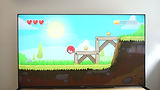
When we tried playing a simple game, we encountered a mismatch:
The TV supported gaming, but the remote wasn't designed for it.
As shown in the video below, the remote supported basic movements, but its form wasn't designed around gaming interactions and it lacked some of the buttons and controls needed for finer gameplay.
What We Found
We then interviewed Smart TV users to understand how they used their TVs and remotes in everyday life.
Our research surfaced five key insights:
01
Different needs for a shared TV
Users shared their TVs with people who had different interests and levels of technical familiarity.
02
Limited support for advanced functions
Users felt that the traditional remote did not fully support some of the Smart TV's more advanced features, such as gaming.
03
Preference for simpler interactions
Users wanted easier ways to interact with the TV, including voice control.
04
Unnecessary buttons
Users found that some buttons were rarely used or unclear in purpose, making them feel unnecessary.
05
Preference for physical controls
Users preferred using a physical remote over an app-based controller.
The Problem...
This revealed a tension between the expanding capabilities of Smart TVs and the physical device used to control them:
Smart TVs were becoming more capable, while the remote remained largely the same.
A single Smart TV could support different people and activities, but its physical controller was still optimized primarily for conventional TV interactions.
Gaming made this mismatch particularly visible and gave us a concrete activity through which to explore a more adaptable remote.
How might one physical remote support both everyday TV use and gaming?
I proposed a remote that could physically change configuration depending on how the TV was being used.
Design for What? Design for Whom?
We focused on novice or casual gamers who were interested in gaming but might not want to invest in a dedicated gaming console.
Our target users already had access to a Smart TV shared with other members of their household. We weren't trying to replace specialized gaming hardware.
The Two Directions
We explored two directions: virtual controls and a physical controller.
01 The Virtual Controller
One direction turned a mobile device into a customizable gaming controller with a joystick, D-pad, keyboard, voice chat, recording, and customizable buttons.

02 The Physical Controller
The other explored a 2-in-1 TV remote and gaming controller whose physical form could transform depending on the activity.
.png)
Because our research indicated that users preferred a physical remote over an app-based one, we continued developing the physical concept.
The "One for All" Remote
A traditional TV remote uses a compact vertical form designed primarily for one-handed interaction, while gaming can require controls distributed across both hands or multiple players.
I looked at how other devices adapted their controls or physical form for different interactions, including mobile gaming controls, in-flight entertainment remotes, Nintendo Switch and Wii controllers, and the transforming device from Futari wa Pretty Cure.
What if the remote could physically transform depending on how people wanted to play?
Instead of designing a separate gaming accessory, we explored a bending and splitting form that allowed one remote to adapt across everyday TV use, individual gaming, and shared play.
Prototyping the Transformation
We built a low-fidelity physical prototype to explore how the remote could change configurations and how the controls would feel when held in different modes.
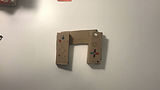
We used the prototype to evaluate the concept across three areas:
Viability
Would people want to use their TV remote for gaming?
Usability
Were the controls positioned intuitively in TV and gaming modes?
Functionality
Did users understand what each button would do in TV and gaming modes?
What We Learned
Testing revealed several limitations and opportunities in the concept.
“I personally wouldn’t use it to play competitive games.”
The concept may be better suited to casual gaming than competitive play.
“I feel like my grandma wouldn’t know how to turn on the TV if the remote was left on gaming mode.”
The remote's current mode needs to be clearly recognizable, especially when the TV is shared by people with different levels of familiarity.
“It’s awkward to use the touch screen.”
Touchscreen controls may not provide the most comfortable interaction for this physical form.
“The volume button should be on the top console in TV remote mode.”
Frequently used controls should be positioned where they are easier to reach while holding the remote.
One remote, multiple ways to interact.
One remote, multiple ways to interact.
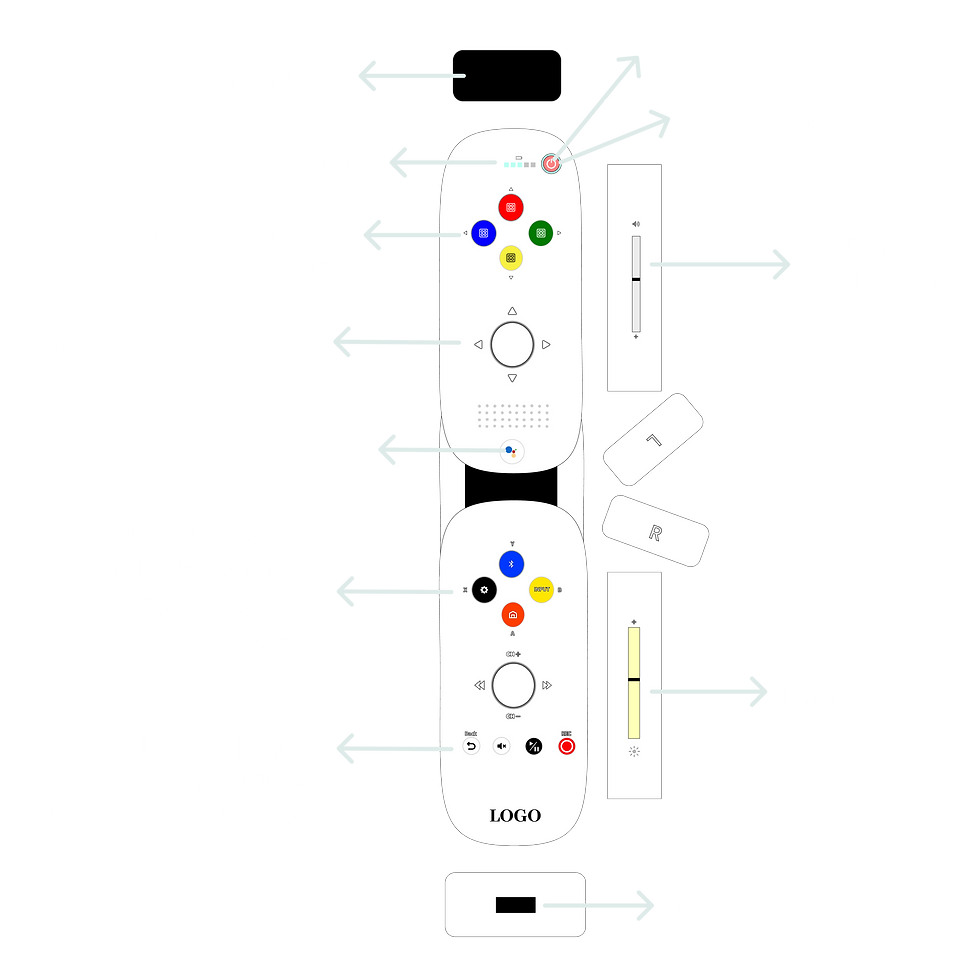
TV Remote
The controller halves connected vertically for familiar everyday TV interactions. It provided familiar navigation, voice, volume, playback, home, input, and other television controls.
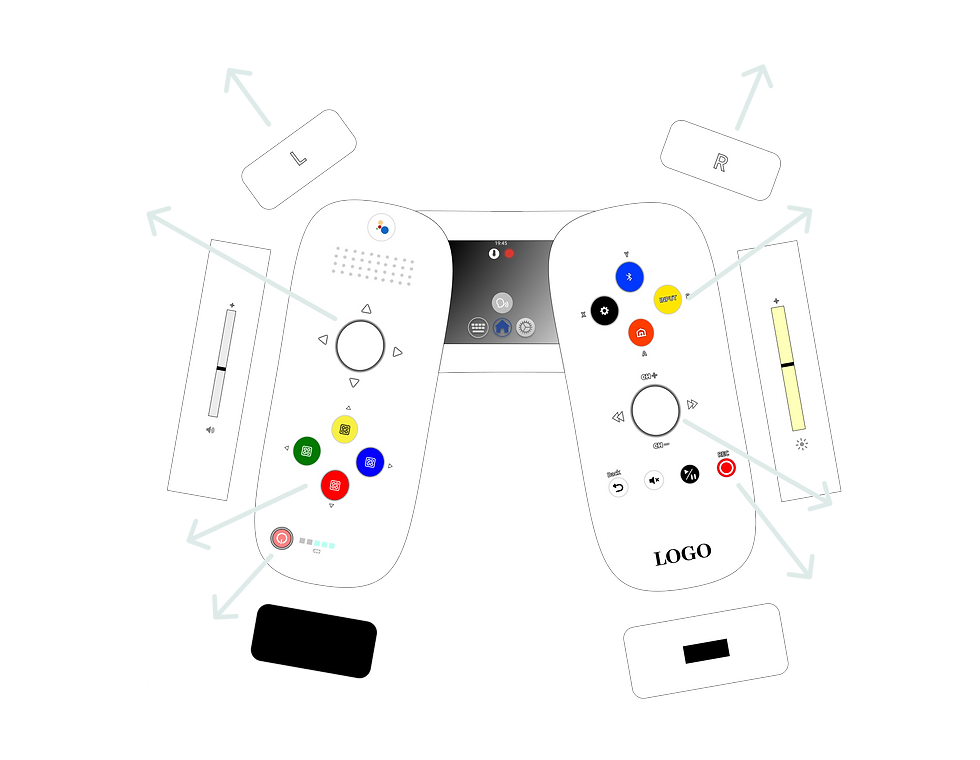
Game Controller
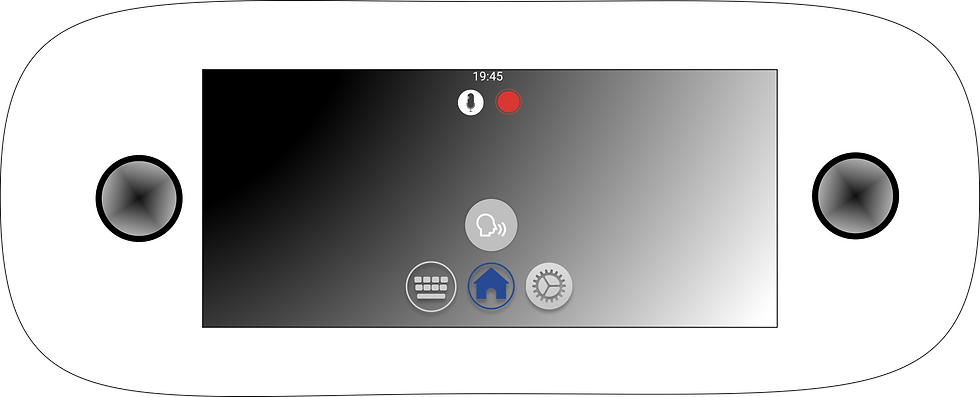
The remote transformed into a two-handed configuration with gaming controls distributed across both sides. It included joysticks, a D-pad, A/B/X/Y buttons, voice control, recording, and left and right bumpers.
Detached Controllers
The two sides could separate into individual controllers for two-player interaction.

Revisiting the Transformation
Looking back at the project, I noticed that while our final concept showed the three intended configurations, the physical transition between them wasn't fully resolved.
The physical prototype explored how the remote could bend and separate, but it didn't clearly communicate how the same components would transition from the straight TV configuration into the angled gaming configuration.
Rather than changing the original idea, I revisited the interaction to make the intended transformation clearer and more consistent across each configuration.
Try it: Click to Transform the remote [ TV Remote → Game Controller → Detached Controllers ]



Reflection
Looking back, the most interesting part of this project was not the final remote itself. It was the idea that one physical interface could adapt to different activities and users. Years later, I also noticed that our final visualization showed the different modes more clearly than the transformation between them. Revisiting that transition helped me separate two problems I had originally treated as one: communicating an idea and fully resolving how the interaction works.
© 2026 by U Lam Lou